
Salesforce org security
- 100 %
- inside your org
- 0
- outbound data by default
- 71
- controls self-assessed out of 255 catalogued
- 10 min
- to install
The French text governs. This page is the English version of Sécurité FR.
39 capabilities. What the Discovery offer opens among them: 2. A free org gets a security core: accounts without MFA, guest exposure, public file links, connected apps and OAuth tokens, holders of Modify All Data and View All Data. Its Security score is never called “Healthy”: at low coverage, “Partial” replaces the green. The rest of the security posture starts with the paid plans.
- 39
- capabilities in this family
- 2
- active on installation day, on the Discovery offer
- Discovery
- entry tier of the family
What this family measures
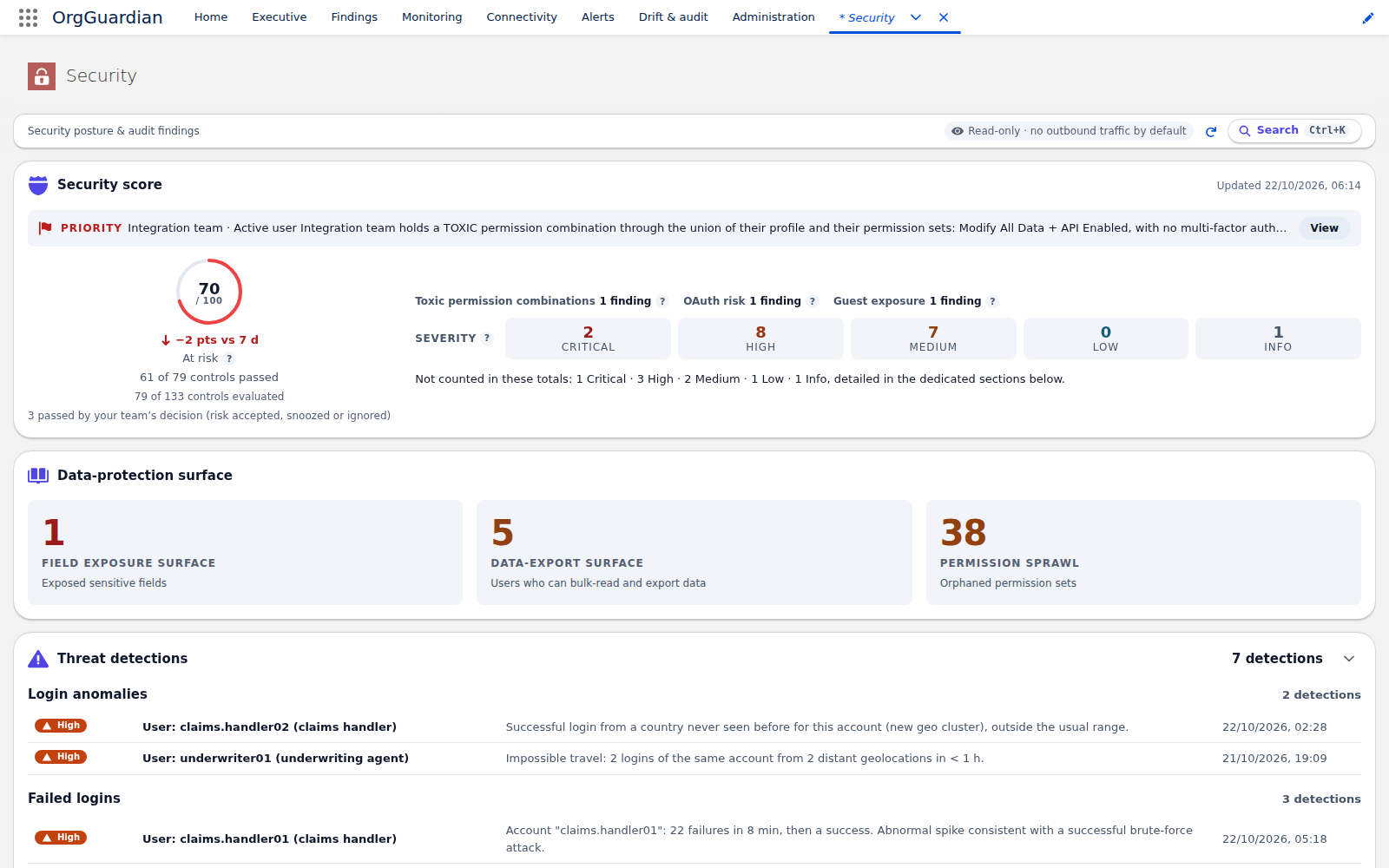
Four angles, in the order of the table — word for word, the four sub-headings you will find below, row by row.
- Identities and their privileges
- who can do what, who no longer uses it, which privileges piled up without ever being removed, and which logins fall outside the ordinary — never-seen country, impossible travel, off-hours login by a privileged account.
- Exposed surfaces
- what your org exposes without authentication, what its public sites let through, which sensitive fields are readable, who can export in bulk, and which connected apps look like an exfiltration tool.
- Data, certificates and agents
- encryption at rest, native classification, certificate expiry, and the security posture of your Agentforce agents — a subject that did not exist two years ago and that no vendor questionnaire asks about yet.
- What you tune yourself
- custom rules, thresholds, per-finding SLA, business criticality scopes, and the costing of risk in euros — with your weights, because an amount computed on the publisher's scale means nothing in your steering committee.
Metrics here too carry stable keys: Security:Score,
Security:PermSprawl, Security:GuestSurface,
Security:OAuthRisk, Security:BlastRadius,
Security:MfaCoverage.
The 39 capabilities, one by one
| Capability | Minimum offer | At install |
|---|---|---|
| Identities and their privileges | ||
Over-privilege postureSecurity_OverPrivilege · the free core reads two of its families: holders of Modify All Data and View All Data | Any paid plan | —, display tier: nothing to toggle, the offer is enough |
Profile / permission set creation and sensitive-identity monitoringSecurity_PrivilegeContainer | Any paid plan | Open |
Permission-sprawl detection (Security)Security_PermSprawl | Any paid plan | Closed |
Dormant-user postureSecurity_DormantUsers | Any paid plan | —, display tier: nothing to toggle, the offer is enough |
Role hierarchy exposure (Security)Security_RoleHierarchy | Any paid plan | Open |
Privilege matrix and consolidation planSecurity_PrivilegeMatrix · shows the grid and proposes a consolidation plan; it changes no permission | Any paid plan | Open |
Public group and queue exposureSecurity_PublicGroups · third effective-access channel, after org-wide defaults and the role hierarchy | Any paid plan | Open |
User access reviewSecurity_AccessExplorer · lists every right the configuration grants a user and where it comes from, exportable to CSV as review evidence; record access is not evaluated | Any paid plan | Open |
Login anomaly detection (country, impossible travel, off-hours) (Security)Login_Anomaly · no Shield required: derived from LoginHistory and LoginGeo, at every scan | Any paid plan | Closed |
Identity verification failuresSecurity_IdentityVerification · `VerificationHistory`, a standard object — no Event Monitoring: a `ReportedDenied` means the user declared the request was not theirs | Any paid plan | Open |
Backup and restore postureSecurity_BackupPosture | Any paid plan | Open |
| Exposed surfaces | ||
Guest-user exposureSecurity_Guest | Discovery | —, display tier: nothing to toggle, the offer is enough |
Public site posture and site-to-guest inventory (Experience Cloud)Security_SitePosture | Any paid plan | Open |
Field exposure scanner (sensitive fields, FLS) (Security)Security_FieldExposure | Any paid plan | Open |
Data-export risk detection (Security)Security_DataExport | Any paid plan | Open |
Event Monitoring security events (Security)Security_EmEvents · with Shield or the Event Monitoring add-on: report exports, Bulk API 2.0 jobs, Login As sessions and Threat Detection anomalies over the last 7 days; without the license it reads nothing, and a family with no event is declared not measured | Any paid plan | Closed |
API data exfiltration detectionSecurity_ApiExfiltration | Any paid plan | Open |
CORS allowlist exposureSecurity_Cors · `CorsWhitelistEntry`: a pattern listed there lets a third-party domain’s JavaScript call the REST API under the signed-in user’s session | Any paid plan | Open |
Authentication entry pointsSecurity_AuthSurface · the login paths that bypass your IdP. Deliberately partial: the two `MyDomainSettings` switches that would close them are not readable from Apex; the finding says so and gives the Setup path | Any paid plan | Open |
API clients: first use and expanding usageSecurity_ApiExfil_Clients | Any paid plan | Open |
OAuth app postureSecurity_OAuth | Discovery | —, display tier: nothing to toggle, the offer is enough |
Toxic combinations analysisSecurity_BlastRadius | Any paid plan | —, display tier: nothing to toggle, the offer is enough |
Attack pathsAttack_Path_Engine · composes OPEN findings into named paths per principal; it adds no detector | Any paid plan | Open |
| Data, certificates and agents | ||
Encryption at rest for regulated dataSecurity_Encryption | Any paid plan | Open |
Native data classification (sensitivity level, compliance)Security_DataClassification | Any paid plan | Open |
Certificate and TLS expiry monitoringCert_Monitor · org certificates read through a self-call through a named credential, never the session token; the external TLS probe goes through the hosted viewer and needs its consent | Any paid plan | Closed |
Outbound endpoint reachability probe (Callouts)Connectivity_Probe · active probe: an outbound call goes to the endpoint you designate | Any paid plan | Closed |
Agentforce AI agent security postureAgentforce_Posture | Any paid plan | Closed |
Data Cloud postureData_Cloud_Posture | Any paid plan | Open |
Pre-encryption impact analysisSecurity_EncryptionImpact | Any paid plan | Open |
Field history tracking postureSecurity_FieldHistory | Any paid plan | Open |
| What you tune yourself | ||
Custom rulesCustom_Rules | Any paid plan | Closed |
Detector tuningDetector_Tuning | Any paid plan | Closed |
Finding SLAFinding_SLA | Any paid plan | Closed |
Business criticality scopesCriticality_Scoping | Any paid plan | Closed |
Cost of riskCost_Of_Risk · adjustable weights: the amount is yours, not an imposed scale | Any paid plan | Closed |
Accepted-risk policiesAccepted_Risk_Policy | Any paid plan | Open |
Rule portabilityRule_Portability | Any paid plan | Open |
Natural-language queryNL_Query | Any paid plan | Open |
— display tier: nothing to toggle, the offer is enough
Source: read from the package code at the moment this page is built — FeatureGate.FEATURE_TIER for the offer, FeatureGate.CODE_DEFAULTS for the state at install, and for the label the full resolution of FeatureToggleAdminController: the enablement guide’s catalogue first, the GateLabels custom labels next, and failing that the technical name as is. The editor’s labels — the whole column, not just that fallback — ship in English: master language en_US, and the package carries no translation file: these are the exact strings your administrator reads in the feature editor, and the site build fails if any of these lists moves without the others. “Closed” does not mean absent: the capability is shipped, it is waiting for a human to open it inside the org — and a capability whose implementation nothing in the package can reach appears on none of these pages: the build drops it instead of selling it.
What this family does not do
- No remediation. The product does not remove a permission, close a guest access or revoke a token. It names, it costs, it ranks; you decide.
- It does not read your business data. It reads the configuration and the metadata describing who may see what. It does not walk your records and does no content DLP and no antivirus.
- It is not a penetration test. A detector observes one named facet; it does not prove the absence of an attack path it does not observe.
- It is not a SIEM. Login anomalies are derived from
LoginHistoryandLoginGeoat every scan; they do not replace continuous event correlation. - Every query runs with your rights. What the user running the scan may not see, the product does not see either — and it says so instead of concluding “healthy”.
The other families
Is this family in your offer? The grid says so line by line.
See the pricing grid Back to the seven families